Landfill Liners, Capping, and Future Expansion

Schilling Landfill Cells 1-7

Sanitary Landfill Liners

There are 7 lined cells located on the inactive Schilling landfill. Cell 7 officially closed in April 2025.

Cell 1

Cell 1 opened in August 1991 and reached capacity in late 1996. The cost for construction of the lined area was $400,000 per acre.

The liner system of Cell 1 is composed of 9 layers:

  1. 6 inch clay
  2. 16 ounce of Geotextile Polyfelt (like a wool blanket or a felt material)
  3. 60 mil high density Polyethylene liner (may be either smooth or textured depending on how resistant to slipping the design required, and resistant to tears, chemicals, and punctures)
  4. 16 ounce of Geotextile Polyfelt
  5. 2 layers of Geo Net-Drainage Netting
  6. 16 ounce Geotextile Polyfelt
  7. 60 mil of high density Polyethylene liner
  8. 16 ounce Geotextile Polyfelt
  9. 18 inches of 1/2 inch stone containing a network of leachate collection pipes
Construction of liner pad 1

Cells 2 & 3
Cell 2 and Cell 3 were constructed in 1995. Cell 2 opened in October 1995 and Cell 3 January 1999. Cell 2 and Cell 3 combined have a life expectancy of 6 to 8 years. The cost for construction of the lined areas was $323,000. Both of these cells were constructed of 6 layers:

  1. 1/4 inch Claymax (Bentonite Clay inside 2 fabrics)
  2. 60 mil high density Polyethylene liner (may be either smooth or textured depending on how resistant to slipping, the design required, and resistant to tears, chemicals, and punctures)
  3. 2 layers of Geo Net-Drainage netting
  4. 60 mil high density Polyethylene liner
  5. 16 oz Geotextile Fabric (non-woven)
  6. 18 inches of 1/2 inch stone containing a network of leachate collection pipes
  1. 1 Construction of Landfill Liner on Cell 3
  2. 2 Construction of Landfill Liner on Cell 2

Cells 4 & 6
Cell 4 and Cell 6 were constructed in 2001. Cell 4 opened in October 2001 and Cell 6 opened in September 2003. Cell 4 and Cell 6 have a combined life expectancy of 10 years. It cost $246,000 per acre just to build these sites. Both of these cells were also constructed of 6 layers:

  1. 1/4 inch Claymax (Bentonite Clay inside 2 fabrics)
  2. 60 mil high density Polyethylene liner (may be either smooth or textured depending on how resistant to slipping, the design required, and resistant to tears, chemicals, and punctures)
  3. 2 layers of Geo Net-Drainage netting
  4. 60 mil high density Polyethylene liner
  5. 16 oz Geotextile Fabric (non-woven)
  6. 18 inches of 1/2 inch stone containing a network of leachate collection pipes
Construction of liner pad 4

Cells 5 & 7

Cell 5 and Cell 7 were constructed in 2007. Cell 5 opened in July 2008. Cell 7 was opened in October 2014 and closed April 2025.

It cost $330,000 per acre just to build these sites. Cell 5 and Cell 7 have a combined life expectancy of about 15 years. Both of these cells were constructed of 6 layers:

  1. 1/4 inch Claymax (Bentonite Clay inside 2 fabrics)
  2. 60 mil high density Polyethylene liner (may be either smooth or textured depending on how resistant to slipping the design required, and resistant to tears, chemicals, and punctures)
  3. 1 layer of Geocomposite Net-Drainage netting (netting with fabric on the top and bottom)
  4. 60 mil high density Polyethylene liner
  5. 16 ounce Geotextile fabric (non-woven)
  6. 18 inches of 1/2 inch stone containing a network of leachate collection pipes

Cell Construction

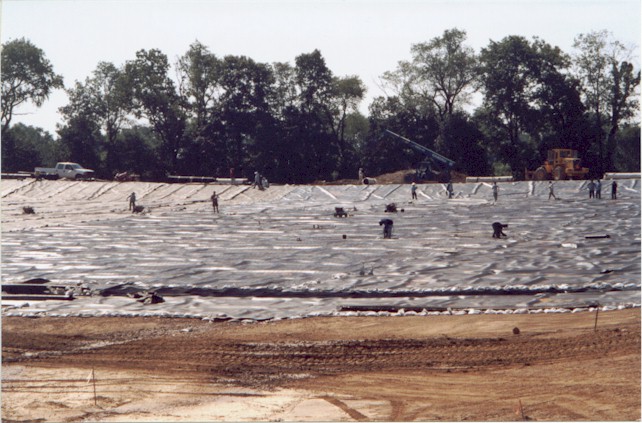
All the material arrives on the site in rolls of different width. The Claymax layer is overlapped when placed. The fabric pieces in the Geotextile layer are sewn together with portable sewing machines. The polyethylene liner is seamed with a portable hot welder which, using heat and pressure together, joins the pieces together in an extremely strong "fusion weld".

"Capping" A Landfill

Closure is the process which a landfill goes through after it reaches the designed elevations. The goal of this process is to design and construct a final cover system that minimizes the percolation of infiltrated precipitation into the waste and the release of harmful landfill gas to the atmosphere. The final cover system is constructed to provide optimal rates of infiltration, evapotranspiration, and run-off which sustain vegetation, prevent erosion and require little or no maintenance.

Typical closure involves "capping" the landfill which includes constructing a final cover, laying topsoil, seeding a vegetative cover to prevent erosion, and constructing surface water diversion systems. Once the landfill cell has been filled, a final cap is installed when the landfill has reached the final permitted grading plan and no additional waste will be placed in these areas.

The final cap is made up of several layers consisting of a foot of intermediate soil cover, a geomembrane plastic liner, a geotextile drainage layer, 18 inches of vegetative subsoil, and 6 inches of topsoil. At the end of the process, the capped landfill cell looks like a small hill with healthy growing grass.

Throughout most of 2019 and into early 2020, GLRA capped half of its permitted landfill cells. The remaining cells will be capped over the next couple of years (2025-2027).
KIMG0083

Landfill Expansion and the Next Generation Landfill

GLRA has been planning for The Next Generation Landfill over the last 10 years. Named for its geographic location, the Heilmandale Expansion will extend the life of the landfill for at least another 20 years. The Heilmandale Expansion includes the construction of six (6) additional landfill cells...Cells 8, 9, 10, 11, 12 and 13.  The construction of its first cell, Cell 8, was completed in 2023.  Cell 8 opened in 2024 to selective compacted MSW to create the base layer of trash on the new cell while all other non-compacted MSW, such as construction and demolition (C&D) waste, was sent to Cell 7.  In April 2025, Cell 8 was opened up to all MSW types operating as the current active landfill cell.  

Since capacity has been reached on the Schilling Landfill (Cells 1-7), the next steps will include capping the remainder of the uncapped Schilling Landfill cells, as well as beginning the process of excavating and screening waste in preparation for the future construction of Cell 9 of the Heilmandale Expansion.
Cell 8

Cell 8

Cell 8 opened in August 2023. The cost for construction of the lined area was approximately $1,000,000 per acre.

The liner system of Cell 8 is composed of 6 layers:

  1. 60 MIL HDPE Secondary Geomembrane
  2. Geocomposite Drainage Net (GDN)
  3. Geocomposite Clay Liner (GCL)
  4. 60 MIL HDPE Primary Geomembrane
  5. 16 OZ/SY Cushion Geotextile
  6. 18 inches of 1/2 inch stone containing a network of leachate collection pipes

Cell 8 Opened